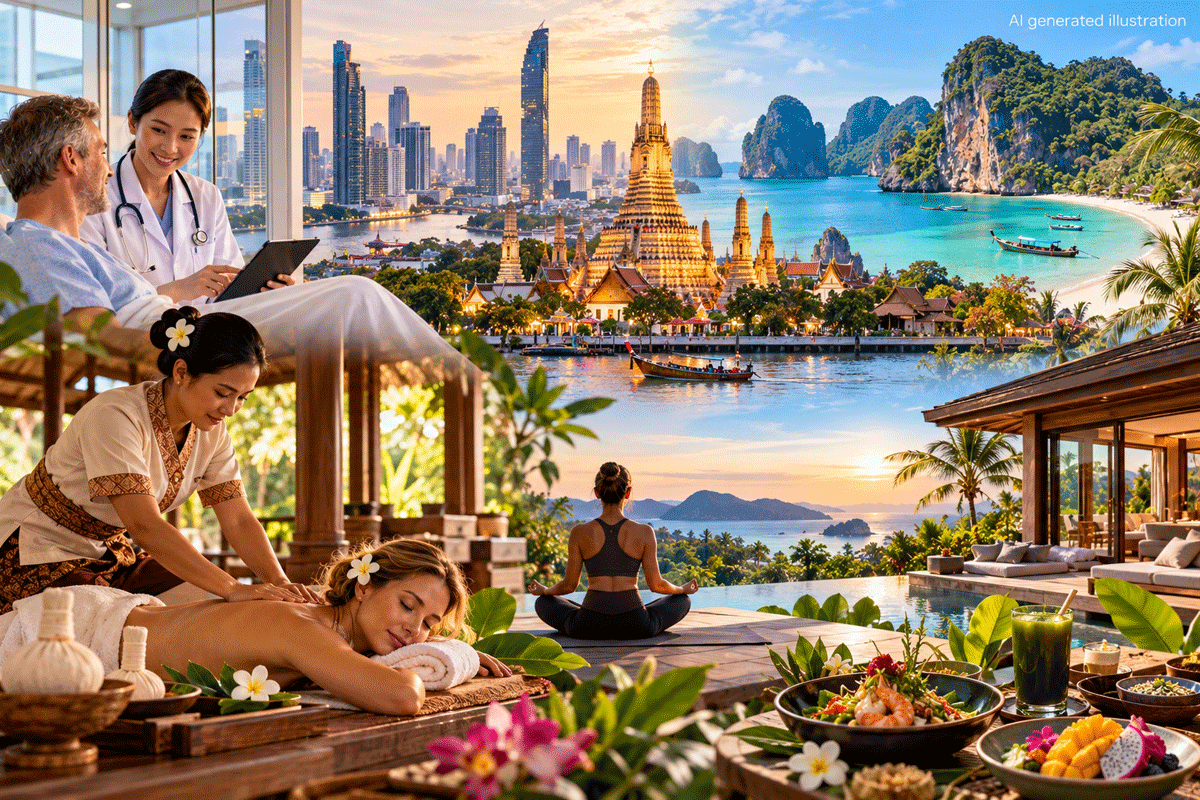
International hospitals, traditional Thai medicine, luxury wellness resorts and emerging longevity programmes make Thailand one of the world's most diversified health tourism destinations
Thailand has developed one of the most comprehensive health tourism industries in Asia, combining internationally oriented hospitals with established leisure destinations, traditional healing practices and a rapidly expanding wellness sector. Bangkok attracts foreign patients seeking specialist consultations, surgery and preventive healthcare, while destinations such as Phuket, Hua Hin, Koh Samui and Chiang Mai offer programmes centred on rehabilitation, physical well-being, relaxation and lifestyle improvement.
The country's position reflects decades of investment in private healthcare and tourism infrastructure. Major hospital groups have developed multilingual patient services, international referral networks and specialist departments, while luxury hospitality operators have increasingly incorporated medical assessments, nutrition, exercise and preventive health programmes into their offerings. This combination allows Thailand to serve different markets, from patients requiring complex treatment to travellers seeking medically supervised wellness experiences.
Recent developments indicate that the distinction between medical tourism and wellness travel is becoming less rigid. Hospitals are expanding preventive and longevity services, resorts are introducing more structured health programmes, and tourism authorities are promoting experiences that connect physical activity with psychological well-being. Nevertheless, these segments differ considerably in their medical evidence, regulation and professional requirements. Thailand's competitive strength lies in the breadth of its offering, rather than in any single therapeutic tradition or medical specialty.
Bangkok anchors the international medical tourism market
Bangkok is the centre of Thailand's international hospital industry. Its private healthcare sector offers services ranging from routine health screening and outpatient consultations to cardiac procedures, orthopaedic surgery, cancer treatment and complex diagnostic investigations. International patient departments commonly provide interpretation, appointment coordination and assistance with medical documentation.
Bumrungrad International Hospital is among the country's most prominent examples. The Bangkok-based institution operates a licensed inpatient capacity of 580 beds and offers a broad range of medical specialties, including oncology, cardiology, neurology, orthopaedics and genomic medicine. Its VitalLife Scientific Wellness Center also illustrates the growing overlap between hospital medicine and preventive healthcare.
According to the company's 2025 figures, Bumrungrad recorded more than 604,000 international medical episodes involving patients from over 180 countries. These figures demonstrate the scale of international demand, but they should not be interpreted as the number of individual medical tourists. The hospital counts treatment episodes rather than unique patients, and its international category includes foreign residents living in Thailand.
Other important providers include Bangkok Hospital, part of Bangkok Dusit Medical Services (BDMS), and the Samitivej hospital network. Both serve international patients through specialist medical departments and multilingual services. Bangkok Hospital Phuket extends this infrastructure into one of Thailand's principal leisure destinations, enabling patients to access hospital services outside the capital.
International accreditation has played an important role in developing confidence among foreign patients. In 2026, Thai government sources reported 61 hospitals and clinics accredited by Joint Commission International. Such accreditation indicates that an institution has undergone an external assessment against defined standards, although it does not guarantee the outcome of an individual treatment.
Thailand's international patient markets include the Middle East, neighbouring Southeast Asian countries and South Asia. For Bumrungrad, Qatar, Myanmar and the United States were its three largest international revenue-contributing countries in 2025. This illustrates the diversity of demand, which extends beyond the traditional image of Western patients travelling abroad primarily to save money.
Dentistry, aesthetic medicine and specialist procedures
Alongside complex hospital treatment, Thailand has developed substantial international demand for elective procedures.
Dental tourism is particularly important because many treatments can be planned in advance and coordinated with relatively short stays. Private dental centres in Bangkok, Phuket and other major destinations offer implants, crowns, restorative dentistry and cosmetic procedures. The Bangkok International Dental Center is one example of a specialist provider with international accreditation.
Plastic surgery and aesthetic medicine form another established segment. International patients seek consultations and procedures involving facial surgery, body contouring and other cosmetic interventions, while dermatology clinics offer a wide range of non-surgical services.
Orthopaedics, ophthalmology, fertility services and selected forms of specialist surgery also contribute to the country's medical tourism offering. However, the suitability of international travel depends on the procedure, the patient's condition and the availability of appropriate follow-up care.
The frequently cited cost advantage remains commercially significant. Thai government and tourism sources estimate that some medical treatments can cost 30 to 70 percent less than comparable services in Western countries. Such comparisons require caution because prices vary by procedure, hospital, clinical complexity and what is included in the quotation.
For international patients, total expenditure may also include flights, accommodation, diagnostic examinations, rehabilitation and possible treatment of complications. Elective surgery requires particular attention to recovery periods, postoperative monitoring and the medical risks associated with flying soon after a procedure.
Wellness resorts move towards preventive healthcare
Thailand's wellness industry provides a second major foundation for international health tourism. Unlike conventional medical travel, which is generally organised around a particular diagnosis or procedure, destination wellness programmes often focus on nutrition, physical activity, stress management, sleep and lifestyle improvement.
Hua Hin has established a strong international identity in this segment through Chiva-Som, one of Thailand's best-known destination wellness resorts. Its personalised programmes combine accommodation with physical activity, nutritional guidance, spa treatments and selected health-oriented consultations. The resort was named Thailand's Best Wellness Retreat at the 2026 World Spa Awards.
On Koh Samui, Kamalaya offers a different approach, combining tropical resort accommodation with programmes addressing stress, emotional well-being, sleep, movement and lifestyle habits. Its international positioning demonstrates the appeal of longer wellness stays in established island destinations.
Bangkok has also developed a distinctive form of medical wellness. RAKxa Integrative Wellness, located in the Bang Krachao area, combines personalised assessments with programmes drawing on conventional healthcare, physical therapies and complementary wellness practices.
The connection between medical expertise and hospitality is becoming more pronounced through providers such as BDMS Wellness Clinic, which offers preventive assessments and specialist consultations while developing relationships with resort operators.
Phuket represents another important growth area. Layan Life at Anantara Layan Phuket Resort offers structured wellness and longevity programmes, combining resort accommodation with health assessments, physical therapies and lifestyle services. Such facilities demonstrate how established luxury tourism infrastructure can accommodate more specialised health-oriented products.
These programmes vary considerably in medical content. A resort offering consultations with qualified physicians is not necessarily equivalent to a licensed hospital, and the availability of diagnostic testing does not establish that every accompanying wellness treatment has demonstrated clinical benefits.
Traditional Thai medicine remains a distinctive asset
Thailand's health tourism identity is closely connected to traditional Thai medicine, massage and herbal wellness practices.
Traditional Thai massage is internationally recognised and widely available in spas, hotels and specialist establishments. Its cultural importance was acknowledged in 2019 when UNESCO included Nuad Thai, traditional Thai massage, on the Representative List of the Intangible Cultural Heritage of Humanity.
Beyond massage, traditional Thai medicine encompasses herbal preparations, compresses and other practices that continue to be used in dedicated institutions and wellness establishments. Some are incorporated into programmes alongside conventional physiotherapy, relaxation and lifestyle guidance.
Chiang Mai is particularly associated with traditional wellness experiences. Its cultural heritage, mountainous surroundings and established hospitality sector support programmes combining massage, meditation, yoga and nature-based activities.
Bangkok also offers opportunities to encounter traditional Thai medicine through specialist facilities and educational institutions. The Wat Pho complex is historically associated with traditional massage education and remains an internationally recognised cultural reference point.
For foreign visitors, these traditions provide experiences that distinguish Thailand from destinations concentrating exclusively on modern clinical services.
Their medical interpretation nevertheless requires care. Evidence supporting individual massage techniques and traditional preparations varies, while some herbal products may interact with medications or be unsuitable for particular patients. Cultural recognition and historical use should not be presented as proof of effectiveness for specific diseases.
Longevity and rehabilitation create additional opportunities
One of Thailand's most visible emerging health tourism segments is longevity-oriented travel.
The term encompasses programmes addressing healthy ageing, physical fitness, nutrition, sleep and preventive assessment. At the more medically oriented end of the market, hospitals and specialist clinics offer cardiovascular screening, metabolic assessments, genetic consultations and other diagnostic services.
Thailand's government has identified longevity tourism as part of its broader health economy strategy. In May 2026, official communications highlighted the potential to combine preventive medicine, resort accommodation and extended stays for international visitors.
The development is commercially attractive because comprehensive programmes may require repeated consultations or several days of supervised activities. However, longevity services also illustrate the need to distinguish established preventive medicine from experimental or insufficiently validated interventions.
Some operators promote biological-age testing, intravenous treatments and regenerative procedures. These services differ greatly in their supporting evidence, regulatory status and medical risks. Claims about reversing ageing or extending lifespan require particularly rigorous substantiation.
Rehabilitation represents a related but more clinically defined opportunity. Thailand's specialist hospitals and physiotherapy providers can support patients recovering from orthopaedic procedures, neurological conditions or other illnesses. Appropriate rehabilitation may involve coordinated medical supervision, physical therapy and accommodation suited to reduced mobility.
Combining treatment and recovery within the same destination can reduce some logistical difficulties, but it also requires continuity between hospital teams, rehabilitation providers and the patient's doctors at home. Travelling to a resort immediately after major surgery is not automatically appropriate.
Tourism infrastructure strengthens international accessibility
Thailand's established tourism industry provides advantages that newer medical destinations may find difficult to reproduce.
Bangkok's Suvarnabhumi and Don Mueang airports support extensive international and regional connections. Phuket and Chiang Mai also have international air services, while Koh Samui is connected through domestic and selected international routes.
The country's accommodation sector ranges from urban hotels near major hospitals to serviced residences and high-end resorts. This diversity can be particularly useful for patients requiring extended stays, accompanying family members or accessible accommodation.
Tourism authorities are seeking to capitalise on these strengths. Thailand's medical hub strategy for 2025–2034 includes plans to strengthen medical innovation, expand international cooperation, support health-related investment and develop the country's medical and wellness industries.
The Tourism Authority of Thailand has reported average expenditure of approximately 107,662 baht per trip among medical and wellness travellers, more than twice the amount spent by general tourists. The figure underlines the economic importance attributed to the sector, although it combines different traveller categories and should not be treated as an average for hospital patients alone.
Government initiatives in 2026 have also promoted Thailand as a destination for health excellence, with greater emphasis on preventive care, active lifestyles and wellness experiences.
For regional destinations, these developments create opportunities beyond direct hospital revenue. Longer stays can generate demand for accommodation, transportation, specialist travel services and activities suitable for patients and accompanying relatives.
Quality, transparency and continuity of care
Thailand's extensive range of health tourism services also creates challenges for international consumers.
Quality and clinical capabilities differ between major tertiary hospitals, specialist outpatient centres, aesthetic clinics and wellness establishments. Accreditation, professional licensing and the availability of emergency facilities should therefore be assessed in relation to the specific service being considered.
Patients travelling for surgery need reliable information about clinical risks, postoperative care, complication management and the qualifications of the professionals involved. They should also establish whether their insurance covers planned treatment abroad and how follow-up care will be arranged after returning home.
For wellness travellers, transparency is equally important. Programmes should distinguish between medically indicated interventions, evidence-based preventive activities and treatments promoted primarily for relaxation or personal well-being.
The country's expanding longevity market makes this distinction especially relevant. A combination of sophisticated diagnostics, luxury accommodation and traditional wellness does not necessarily provide evidence of improved long-term health outcomes.
Thailand must also balance international demand with the healthcare needs of its domestic population. Investment in premium private services can support employment and medical infrastructure, but the wider implications for workforce distribution and access to care remain important policy considerations.
Thailand's position in international health tourism rests on an unusually broad combination of established hospital services, specialist elective procedures, traditional healing practices and sophisticated wellness hospitality. Its major destinations complement one another rather than competing through identical offerings: Bangkok concentrates advanced medical services, Phuket and Koh Samui connect healthcare with resort tourism, Hua Hin specialises in destination wellness, and Chiang Mai contributes traditional and nature-based experiences.
The country's next phase of development will be shaped by the integration of preventive medicine, rehabilitation and longevity services into this existing infrastructure. For international patients and wellness travellers, Thailand offers considerable choice. Its continued credibility as a health tourism destination will depend on ensuring that medical quality, transparent information and responsible treatment standards develop alongside commercial expansion.
Image Credit: © AI generated illustration